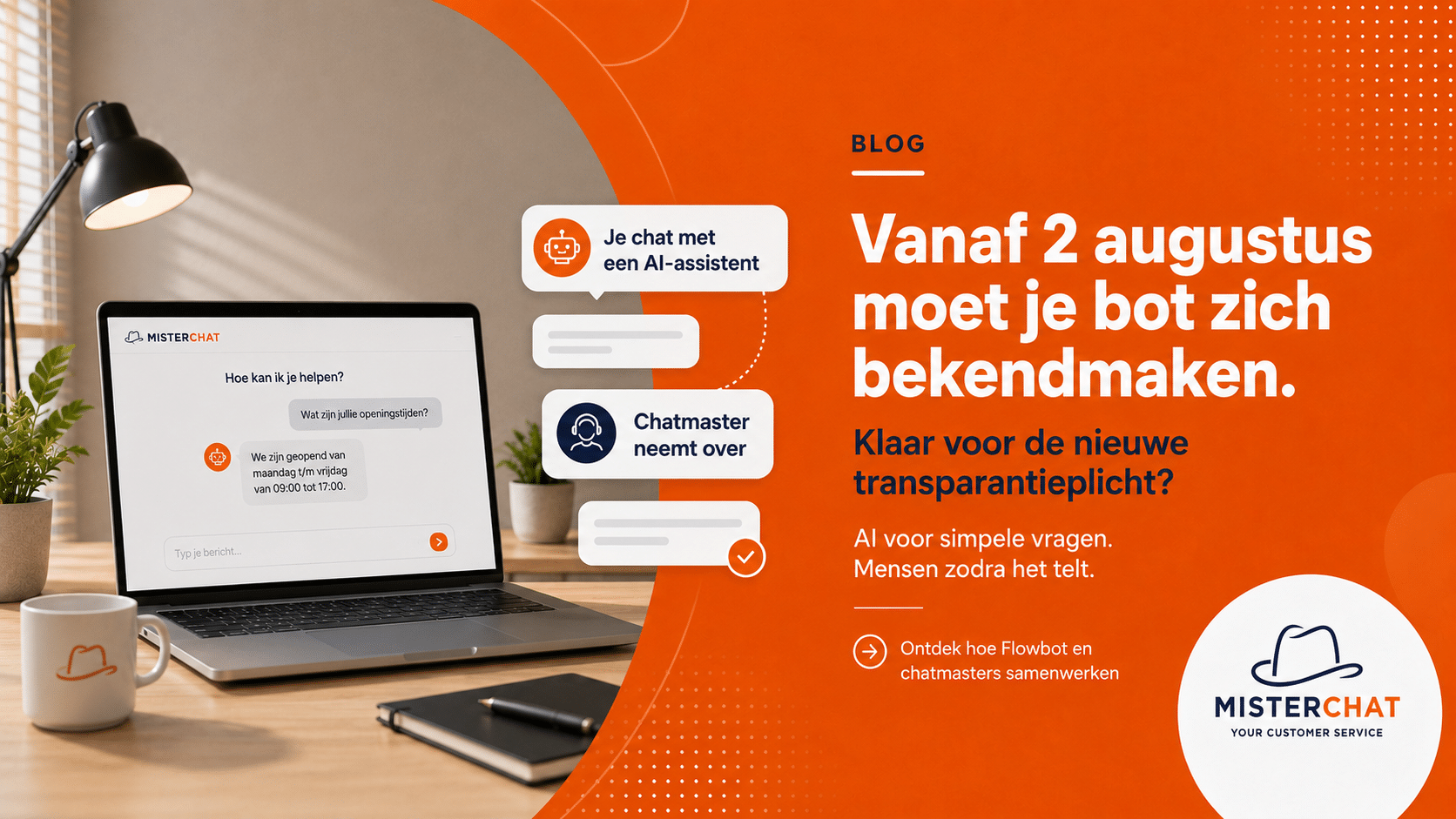
Your customer opens the chat on your online store with a question about their order. Until recently, they might not have even noticed right away whether an employee or a bot was responding. Starting August 2, 2026, that will change. That’s when the European transparency requirement for AI takes effect, and you’ll have to make it clear in advance that the customer is talking to an AI assistant.
Starting August 2, your bot must identify itself. Are you ready?
9.4 / 10
What exactly is changing?
The rule comes from the European AI Regulation and is simple: if you use a chatbot or voicebot in your customer interactions, the customer must be informed of this at the outset. A visible notification such as “You are chatting with an AI assistant” is sufficient. No fine print, no ambiguity. In and of itself, that’s good news for trust, because people want to know who or what they’re dealing with.
Transparency exposes the weak spot
There’s just one downside. As long as a customer wasn’t sure whether they were talking to a human, they’d give a stuttering chatbot the benefit of the doubt. Once they know it’s a bot, that patience disappears. Expectations rise, and tolerance falls. If the bot then gets stuck on a question that falls just outside the script, the customer doesn’t feel helped—they feel brushed off. And that’s exactly where it goes wrong: the National Voice Monitor shows that only 12 percent of questions asked of a chatbot are answered to the customer’s satisfaction. Making it clear that it’s a bot only serves to highlight that 88 percent even more painfully.
The solution isn't less AI, but AI in the right place
The answer isn’t to just turn off your bot. AI excels at quick, simple tasks: where’s my package, what are the hours of operation, how do I return an item. It’s perfectly fine for the customer to get that information from the bot. Things go wrong when you expect that same AI to also handle the difficult conversation—the customer with a complaint, the one who’s on the fence, or the case that’s just a little different. That’s when people want a human. The trick is in the handoff: automate what you can, and seamlessly transfer the call to an employee when it really matters.
How MisterChat Solves This
MisterChat takes over all or part of your customer service, with real chat experts available 24/6.
We operate on a hybrid model, which is exactly what this law requires. Our Flowbot transparently handles frequently asked questions and clearly states that it is an AI assistant. As soon as a conversation requires human interaction, one of our chat masters takes over—in your tone of voice—via chat, phone, WhatsApp, email, or social media. The customer doesn’t notice a disruption—only that they’re being helped. This way, you meet the transparency requirement and keep satisfaction high, without having to handle any technical or staffing arrangements yourself.
The transparency requirement is not a reason to turn our backs on AI. It’s a reason to use it more intelligently, with the right people in the right places. Do you want to be ready for this by August 2?
From outsourcing to strengthening—that’s MisterChat
At MisterChat, we don’t take over your customer interactions—we enhance them.
We ensure your business is always accessible, without you losing control.
- Available from 6:00 a.m. to midnight
- Multilingual customer service (NL, EN, ES, and more)
- Real people, not bots
- Seamless integration with your systems
- Reports, dashboards, and insights into every conversation
Whether it’s customer service, lead follow-up, after-sales support, or live chat support—MisterChat is your professional partner.
You stay in control; we ensure continuity, speed, and satisfied customers.
Ready to organize customer interactions more effectively?
Contact MisterChat and discover how we can help your business grow with service that remains human and results that are measurable.
MisterChat – Your brand. Your customer. Our service.